Personal injury in one file, from notification to settlement
The agents do the paperwork. The people do the contact.
Working on income protection claims? To Income protection

It is a chain problem
Inside the insurer the process runs. The work sits before it, between it and after it, and it lands on fewer people every year.
-
Before: the claim trickles in
A letter of claim from the solicitor, a portal notification, a phone call. Three entrances for one incident, retyped into the system.
-
Inside: the process runs
Once the insurer is in contact, it flows. A named handler, a track by severity, deadlines in view. That is not where the gain is.
-
Between: twelve inboxes
Claimant solicitor, medical agency, rehabilitation provider, engineer, each in their own environment. The MedCo report hangs on the wrong thread.
-
After: it comes back
What is not captured at the front comes back at the end as chasers, costs under the fixed recoverable costs regime, complaints and the Ombudsman.


From sixty-six lines to one hub
Twelve parties in a heavy personal injury file, and every party can talk to every other: 66 lines. Today almost all of that traffic is bilateral, by email, letter and phone.
Claimant · claimant solicitor · handler · legal expenses insurer · medical experts · rehabilitation provider · loss adjuster · outsourcing · recovery parties
Connect once, work with everyone
Whoever connects to Claim360 works with everyone who is connected. Insurers, claimant solicitors and outsourcing partners in the same file.
-
Connect once
Every party connects to Claim360 once and from that moment works with every insurer running Claim360. No twelve portals, no bilateral integrations.
-
A workplace for solicitors and outsourcing
Claimant solicitors and outsourcing partners get a complete workplace: files, tasks, deadlines, messages, documents and the schedule of loss. Only time recording and billing stay with them.
-
Control over your partners and the chain
You see per partner what is running: cycle time, open deadlines, chasers, costs and reserve per head of damage. Access per role, every action logged, revocable at once.


Click through Jennifer's journey
Self-service is not a form on a website. It is a file that explains itself, from notification to settlement. The handler sets the limits and decides; the chain works along instead of alongside. Click a step.
- Self-service Jennifer does it herself, when it suits her. No queue.
- Trust Every step shows what is happening and what comes next.
- High data quality Fields instead of attachments, everything checked on arrival.
- Knowing where you stand Status, deadline and next step, without calling.
- Control of the chain Solicitor and medical expert in the same file, each with their own rights.
Notifying without a policy number, in eleven steps
Sunday evening, twenty minutes, in fields. What Jennifer enters is read and checked in the background. Nothing has to be retyped later.
Knowing at once that she is in the right place
Registration in, DVLA and policy alongside. Cover on the date of the accident is confirmed, a duplicate claim is linked at once.
Her own words become facts
Role, direction, right of way and point of impact come out of her story. If it does not match the sketch, she gets one targeted question.
Photos and receipts read and checked
No medical data at the front door, but enough to route properly. Every document checked for authenticity. Minor injury: the short route.
A file, a handler and a deadline
Claim number, Emma as named handler and the counter to the liability decision. Everything is in the core system on day one.
Her file, with the chain in it
Status, parties, interim payment and next step on one screen. Her solicitor and the medical expert work in the same file.
A receipt added, straight to Emma
A photo of the physio receipt. Amount and date are read, the line is in the schedule of loss and the balance moves with it.
Settlement, payment, file closed
The settlement agreement comes as a draft from the file and is signed in the portal. The file closes for everyone at the same time.
Three layers, one file
Your core system stays. Claim360 connects the chain and lets deadlines, tasks and payments run by themselves; the portal brings the data in properly; and only then does AI work.
The build
AI
- the user's permissions
- every question logged
Your model, a partner's or our Claimassistent, through Claim360 as the gateway. Reads, checks and prepares; the handler decides.
Self-service portal
- fields instead of attachments
- per role
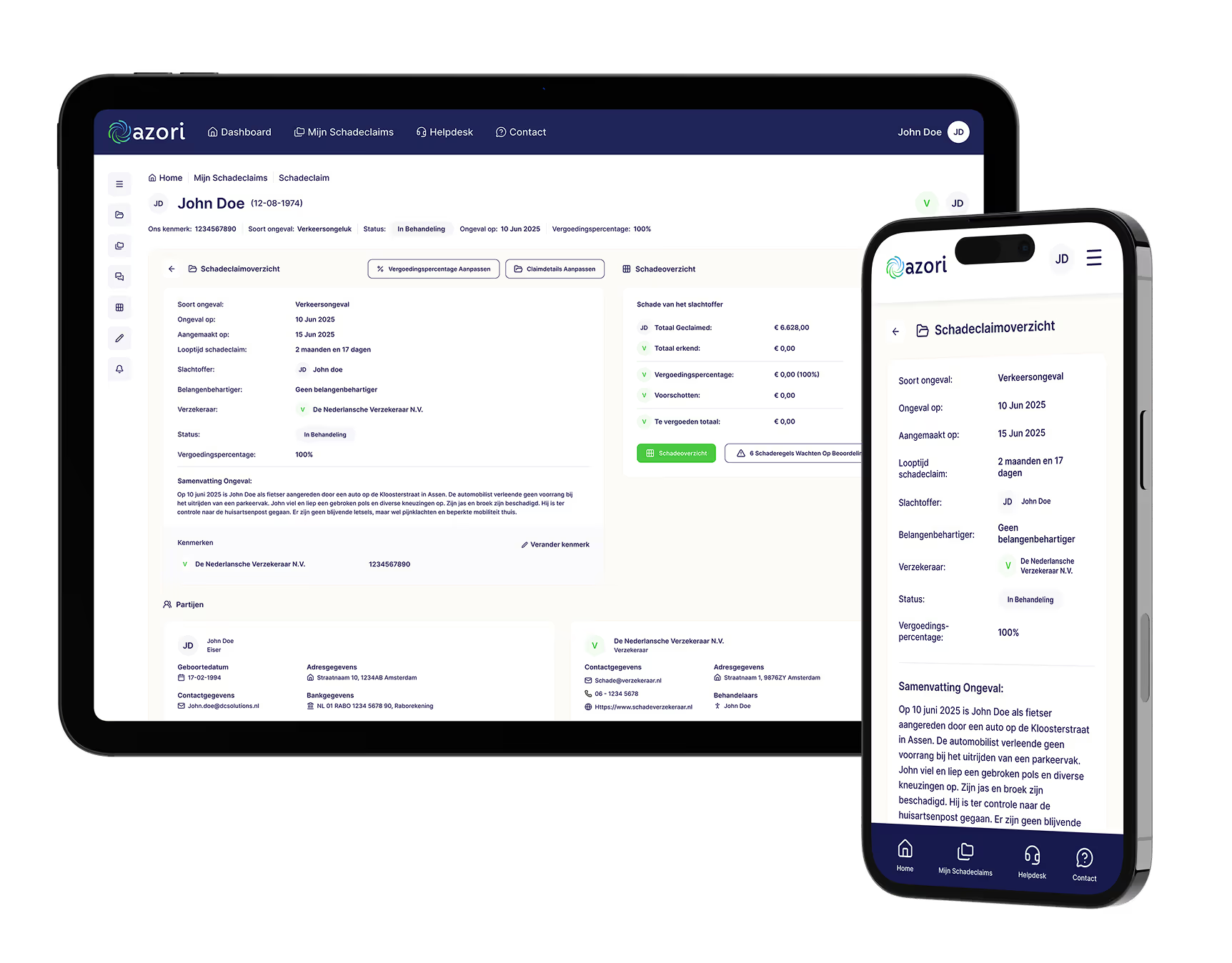
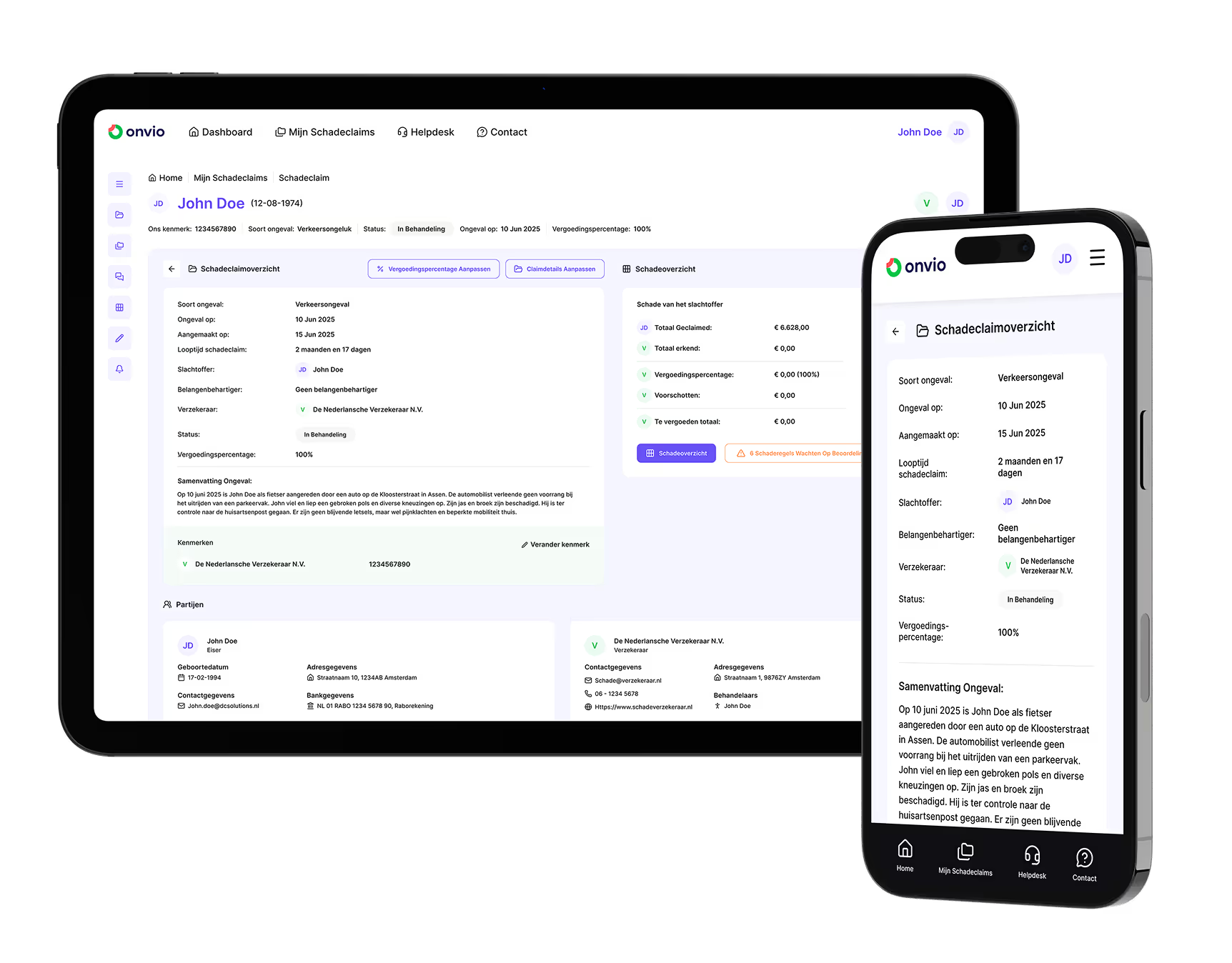
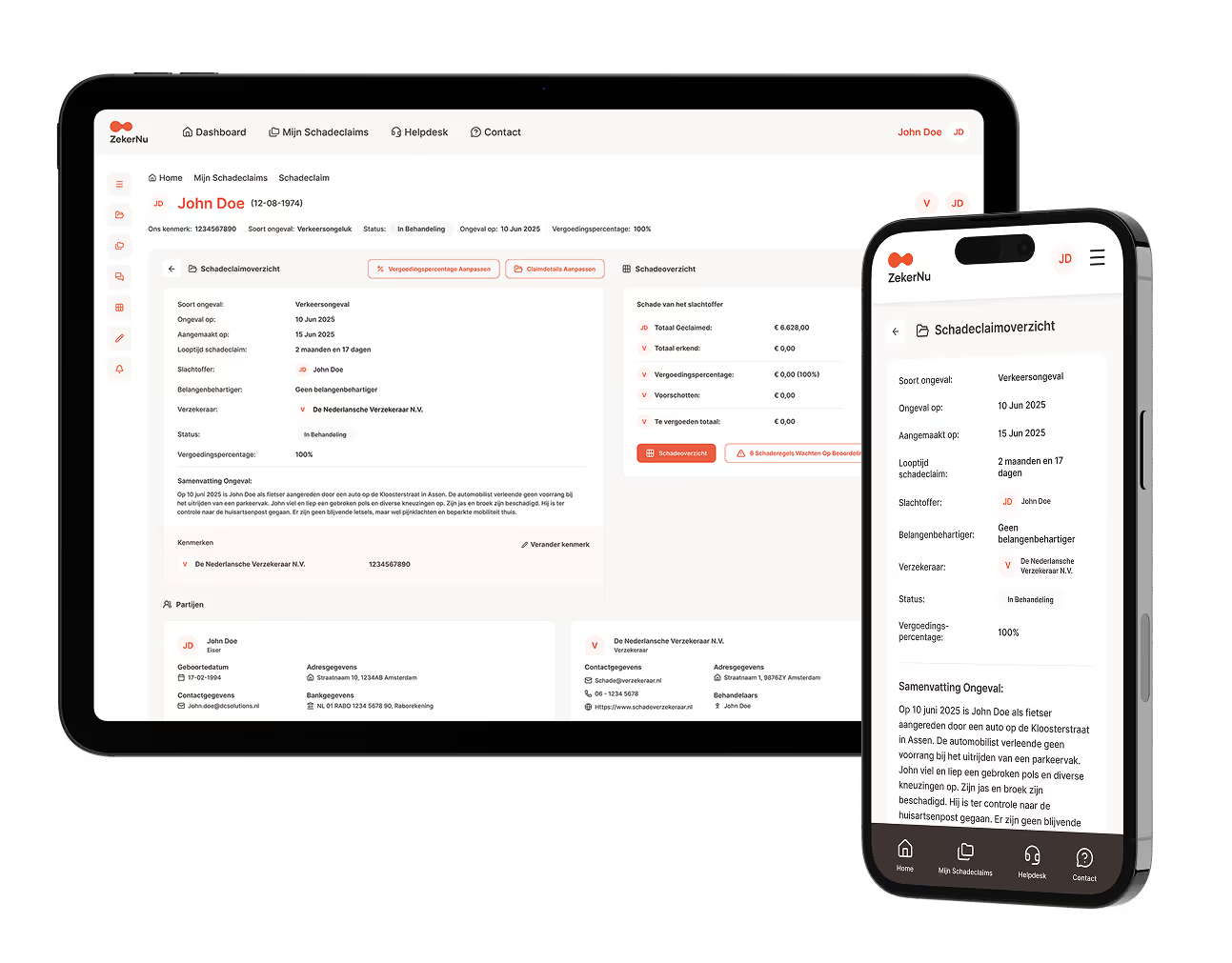
Azori, in your brand. Claimant, solicitor, chain partners and handler in the same file; everyone sees what their role needs. Runs on Claim360.
Claim360: orchestration and workflow automation
- deadlines, tasks, payments
- roles and permissions
- direct API per chain partner
- writing back to the core
This is where the intelligence sits. Deadlines, tasks, documents and payments run by themselves; roles, permissions and triggers across the core system; what has to go back, goes back to the core.
Your core system
Keylane Axon, Novulo, CCS, UBench, Guidewire and Anva or another: it stays. Claim360 connects to it and writes back. See the integrations
Start small and at the base: self-service first
One portal for minor injury, next to what you have. Then the chain, then AI. First pilot live in 8 to 12 weeks.
- Step 1
web form and portal
Start with a pilot
The claimant notifies without a policy number and follows the file. Only new minor claims, one stream, running within weeks. Baseline alongside.
- Step 2
solicitor, expert and the three-way conversation
Add the chain
The same parties in the same file, permissions per role, protocol deadlines in one workload. You can stop at any time, the data stays yours.
- Step 3
basics in order
AI and beyond
Summary, triage and draft reply through the MCP gateway, with your own models and the same permissions as the handler.
The core
We automate the paperwork around the file, so your handlers keep time for the claimant. AI on a file it can read, independent of your system.