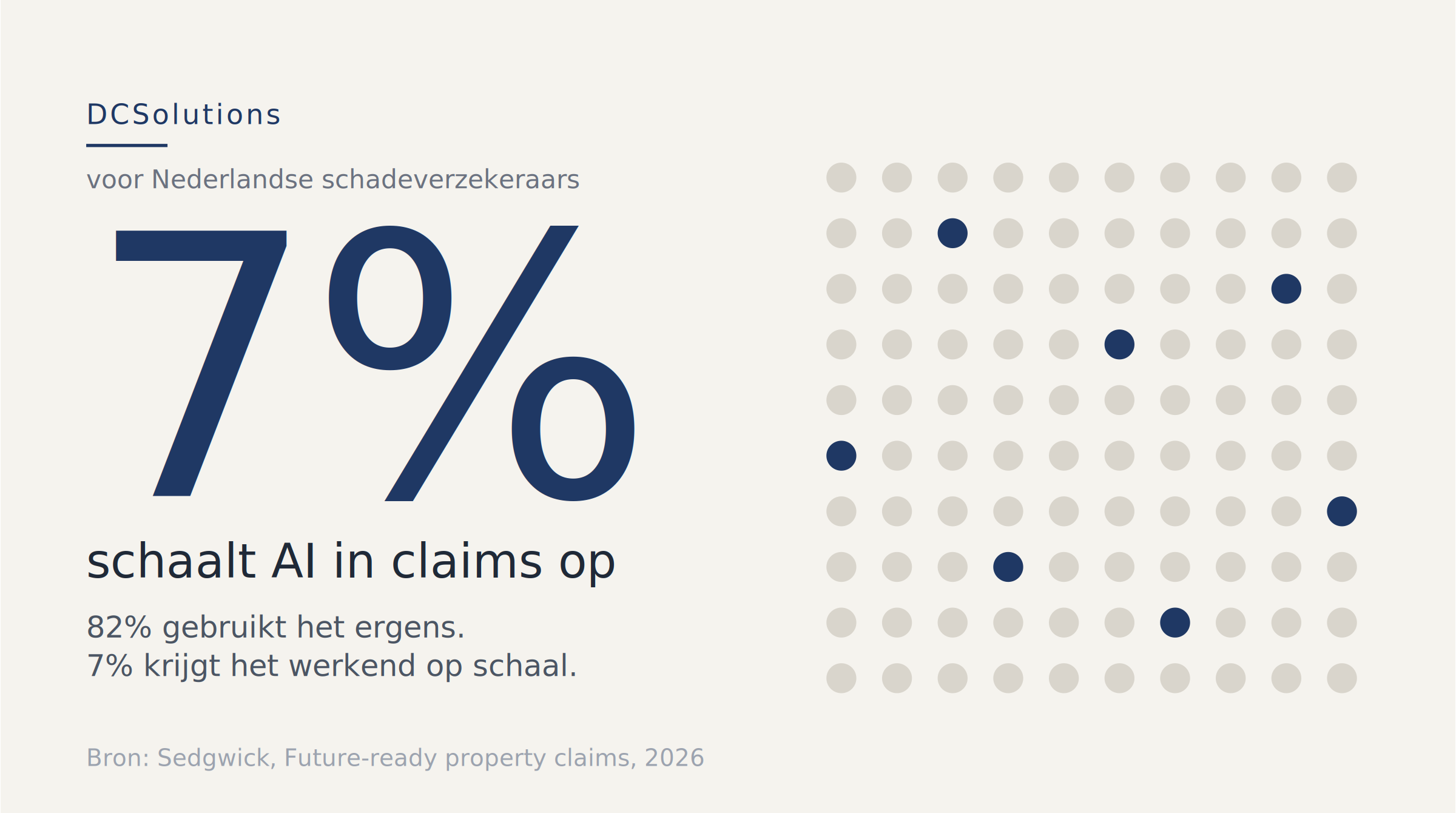
82% of insurers use AI in claims. 7% have scaled it up.

Sedgwick published a report this spring on AI in property claims. The research draws mainly on the American and international property market. That is not the market we operate in. We are sharing it nonetheless, because the patterns match one to one with the conversations we have here with Dutch non-life insurers.
We work with insurers every day on portal and orchestration layers on top of their claims systems. Different lines of business here: disability (AOV), personal injury, passenger insurance (SVI), motor, buildings and contents. Different scale. Different legal framework, with the GBL code of conduct and GDPR weighing more heavily. Similar frustration behind the AI pilots.
Hence this piece. What the report says about scaling up, and what applies to Dutch claims practice.
What Sedgwick found
82% of insurers deploy AI somewhere. 7% get it working at scale. The rest remain stuck between pilot and production.
Nearly two thirds of insurers themselves admit there is a gap between their AI ambition and what is actually in place. Investment is soaring, from 10 billion dollars in 2025 to an expected 80 billion in 2032. A lot of money for a problem that has not yet been solved.
The problem is not tools and not budget. Both are there. The difference between the 7% who scale and the rest lies in how they implement. That conclusion applies to the Dutch market just as much as to the American property portfolios the research is based on.
Why AI in claims stalls after the pilot
Three patterns keep coming back, including in our experience with Dutch insurers.
First, infrastructure. Most claims applications were not built for the API integrations modern AI demands. If you bolt AI onto a legacy platform instead of embedding it in the core workflow, you get trouble. Inconsistent data, duplicate actions, performance that collapses as soon as volume grows. We see that here just as much with older QIS or Guidewire environments as in the US with their equivalent.
Then data. Different AI tools from different vendors handle different steps. The data they produce is often inconsistent or sits in silos. AI is only as reliable as the data that goes into it. At scale, those problems pile up.
And adoption. Claims handlers with full caseloads have no room for tools that feel like extra work. The report mentions another pattern: insurers who demand perfection from AI from day one, instead of measuring progress against what is in place today. That is what kills the enthusiasm.
Where AI in claims does work
The insurers who do get results focus AI on the work where speed and consistency count. Intake, document processing, minor claims, administrative coordination.
The figures in the report are concrete. Intake automation brings turnaround time down from 10 days to 36 hours. AI photo analysis improves claims handling by 54%. Minor claims are settled 80% faster, with a 50% productivity gain on file preparation. Without AI, roughly 30% of a claims handler's time goes on administrative work.
These numbers come from the international property market. For personal injury, disability or passenger insurance in the Netherlands you would not transfer them directly. The direction does hold: on repetitive, rule-based, high-volume work, AI delivers a demonstrable return.
Complex claims, doubtful coverage questions and cases where the victim needs a human being on the other side, that is a different story. The report shows that human-in-the-loop models, where AI supports and the human decides, quadruple trust in AI outcomes. For personal injury under the GBL, that is the only workable model anyway.
What scaling up really takes
The insurers who scale share a few characteristics.
They start narrow. One workflow, clear criteria, data clean enough to work with. Intake is often the starting point because it is high volume and standardised. A measurable win there builds the credibility to roll out further.
They build one coordination layer that all AI steps plug into. An AI that performs one step and knows nothing of the rest creates new seams between systems. Scaling requires a layer that knows the file status across the entire lifecycle. What has happened, what is missing, what needs to happen now. When a document comes in, that means: update the status, trigger the next action, put the file in front of the right handler with the context attached. A tool that only reads documents will not get you there.
In Dutch practice, that coordination is often even more complex than in a US property context. An average personal injury file involves at least three parties actively moving with it: victim, claimant representative and insurer, plus medical advisers, occupational experts and recovery chains. Every handover is a place where context disappears. That is where most time can be won.
They involve handlers early. Whoever sits in the workflow every day knows exactly where it breaks. Having those people think along up front works better than managing their resistance afterwards.
And after launch they put a real owner in place. Pilots need champions. A rollout requires someone operationally responsible for adoption, performance and continuous improvement, even once the launch fireworks are over. Without that role it drifts, even with good implementations.
The misconception about core systems
A common assumption: scaling up requires replacing the core claims system. Usually not.
The friction that slows down claims processes sits in the coordination layer between systems. Documents that come in but never surface with the right handler. Tasks that are ready but nobody flags. Context that disappears at handover. Those are coordination problems. You solve them with an orchestration layer on top of what is already there.
Where DCSolutions fits in
This is exactly where we do our work, for Dutch non-life insurers. Claim360 is our orchestration layer on top of the claims system, with Azori as the optional white-label working environment above it. The core claims system (Axon, CCS, Guidewire or another solution) stays in place. We put a portal and coordination layer over it that brings victims, claimant representatives, external parties and the insurer into one working environment.
What that means in practice:
- Documents that come in via the portal land directly in the right file, with the right status, and trigger the next step. No more mailbox archaeology.
- Victims and claimant representatives see the same statement of damages as the handler. Discussions about what has been acknowledged and what is still open run through a single source. That saves back-and-forth and it saves errors. For personal injury it also means working GBL-compliant without extra trackers on the side.
- AI components plug in wherever they make sense. Intake, document extraction, classification of minor claims, summaries for the handler. As a layer within the work already in progress, with the same file status and the same context.
- Integrations with external parties are part of that same layer. Loss adjusters, repair companies, medical advisers, occupational experts: their input and their status come in via the same route and land in the same place in the file. No separate mailboxes, no Excel trackers on the side.
Demo and client cases
We can show live how this works in a production environment at Dutch insurers. On request we share client cases for:
Disability (AOV). A white-label portal for occupational disability claims, with reintegration and absence flows between insurer, customer and external parties.
Personal injury. The Personal Injury Portal, in which victim, claimant representative and insurer work in one environment on the statement of damages, advance payments and communication, within the GBL framework.
Passenger insurance (SVI). Passenger indemnity insurance, set up for the specific flow of injury within motor insurance.
Supplier integrations. Examples of integrations with loss adjusters, recovery chains and medical advisory parties, including what that delivers in turnaround time and handler time.
What this means for your AI roadmap
The crucial question is which layer you plug AI into. If that layer is missing, every AI investment remains a stand-alone pilot. With a coordination layer in place, you can deploy AI in phases where it delivers a return, without building new integrations between tools every time.
The Sedgwick report measures that in property claims. We see the same dynamic every day at Dutch non-life insurers in disability, personal injury and passenger insurance. The 7% who scale have that layer in order. The rest are investing in loose pieces.
Source: Sedgwick, Future-ready property claims: Leveraging technology and AI for a strategic advantage, March 2026. Press release and summary: PR Newswire. Additional analysis: Risk & Insurance.