Polished output is not yet good output
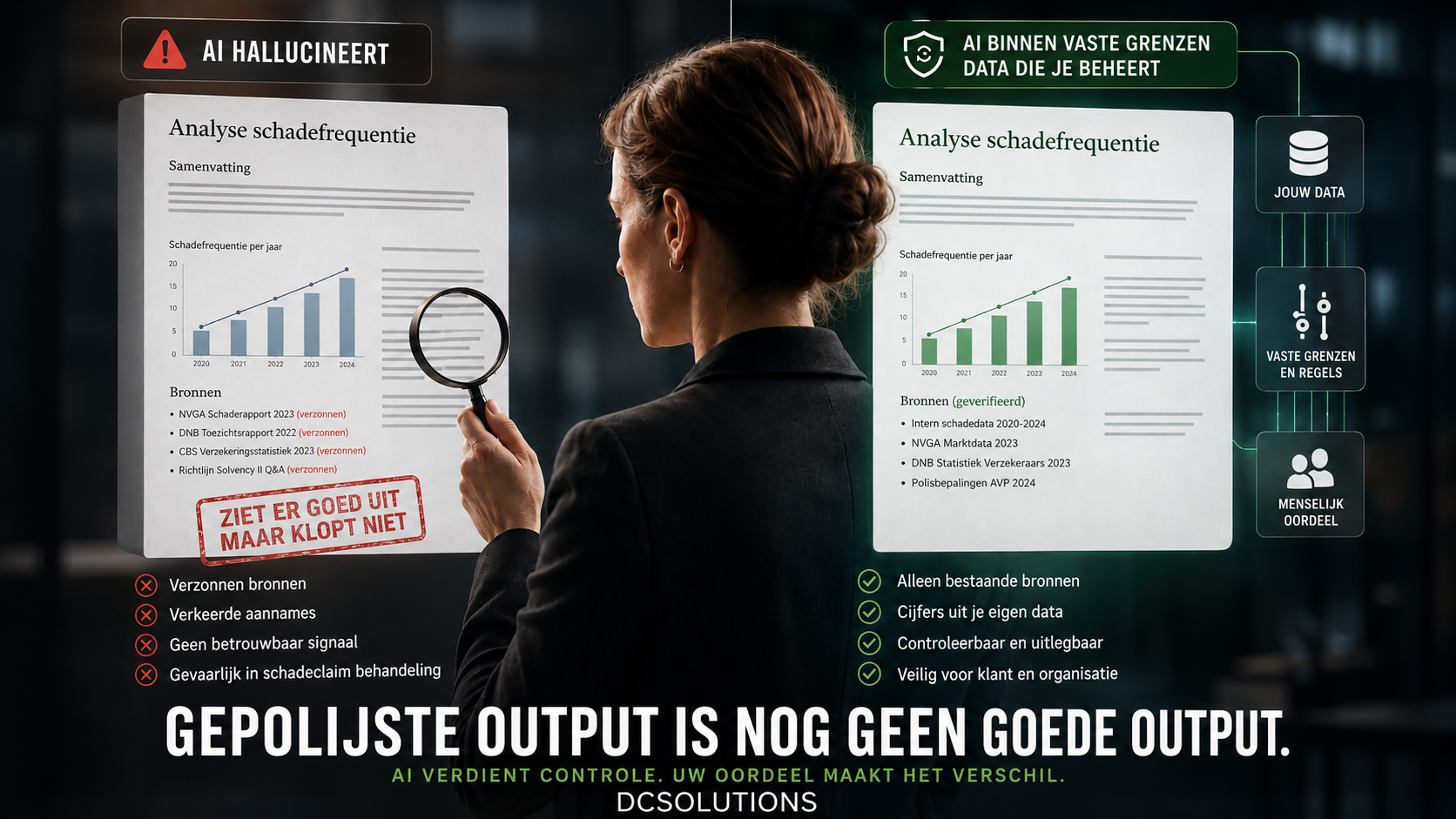

What the AI hallucinations at the Big Four teach us about claims handling
KPMG published a report on agentic AI in October 2025 with 45 sources. Five of them turned out to be correct.
Deloitte delivered a 526-page report, for 1.6 million dollars, to the province of Newfoundland and Labrador in Canada, on healthcare workforce deployment. Fabricated sources ran throughout the document: articles that were never written, authors credited with work they never did.
Deloitte Australia had to refund part of a 440,000 Australian dollar engagement to the government, after the report turned out to contain fabricated academic citations, attributed to real professors of the University of Sydney and Macquarie Law School.
EY Canada withdrew a cybersecurity report. 16 of the 27 citations turned out not to exist.
And in the Netherlands, a lawyer with thirty years of experience filed a petition containing case law that did not exist. When that came to light, she corrected it with three additional cases. Those were fabricated too. The judge put it briefly: 'Either the AI has run wild, or you have invented the case.'
Five organisations, four countries, two sectors. The same pattern every time.
The problem is not in the model
The easy conclusion is that AI hallucinates and that you therefore need to watch out for it. That is true, and by now it is no longer news either. Anyone who has worked with a language model knows it can invent a source that looks convincing and yet does not exist.
The problem lies in the step that did not happen afterwards. At KPMG, at Deloitte, at EY and with that lawyer, there was a draft with sources in it. Someone still had to check those sources before the piece went out the door. That checking did not happen.
That is not a technical error. That is a human error: someone adopted the output because it looked good, not because it had been verified. AI thereby raises the lower bound of presentation. A poorly substantiated piece used to look poor as well, and that was the signal to probe further. Now the same poorly substantiated piece looks polished and convincing. The structure is right, the language holds up, and the weak assumptions are just better dressed. The signal to check has disappeared, while the need to check has actually grown.
Why this weighs more heavily for non-life insurers
With an advisory report from a Big Four firm, the damage is unpleasant: reputational loss, a refund, a painful moment in the courtroom. In claims handling there is more at stake.
A claims file touches directly on a payout, a liability question or a policy interpretation. A fabricated source in that process, a non-existent precedent, a figure based on nothing, is not merely embarrassing when it comes out. It can lead to a wrong payout decision, an unjustly rejected claim, or a file that does not hold up under scrutiny by DNB or a court.
A neatly substantiated piece resting on a fabricated source is more dangerous than a visibly messy one. The messy piece automatically raises the question of whether it is correct. The neat piece does not. It looks customer-ready, and that is exactly the risk.
What is needed instead
The answer is not a better model that hallucinates less often. Models are getting better, but no model guarantees that every source it cites actually exists. The answer lies in the boundaries you build around that model.
That is why at DCSolutions we offer Claim360, which makes it unnecessary for AI to search for sources freely. Claim360 works only within data the insurer manages itself: internal claims data, verified market figures, its own policy provisions and case law that has been recorded. If a source does not exist in that dataset, Claim360 does not invent it. It reports that the source is missing, so that a human can still answer that question.
That is a deliberate choice to let the system sometimes look less impressive than an AI that has an answer for everything. In claims handling, that is exactly the difference between a tool you can trust and a tool you have to debunk afterwards.
AI does not make the judgement of your people redundant. It makes it more important. But then there has to be something that judgement can build on, instead of something that afterwards turns out to have been fabricated.
Polished output is not yet good output.
Sources
- The Big Four are selling AI governance while their own reports hallucinate: startupfortune.com
- Big Four AI Hallucinations: KPMG, Deloitte and EY's Report Failures: big4news.com
- 'Either the AI has run wild, or you have invented the case': : dutchcowboys.nl