Agentic AI in personal injury only works when the file is right
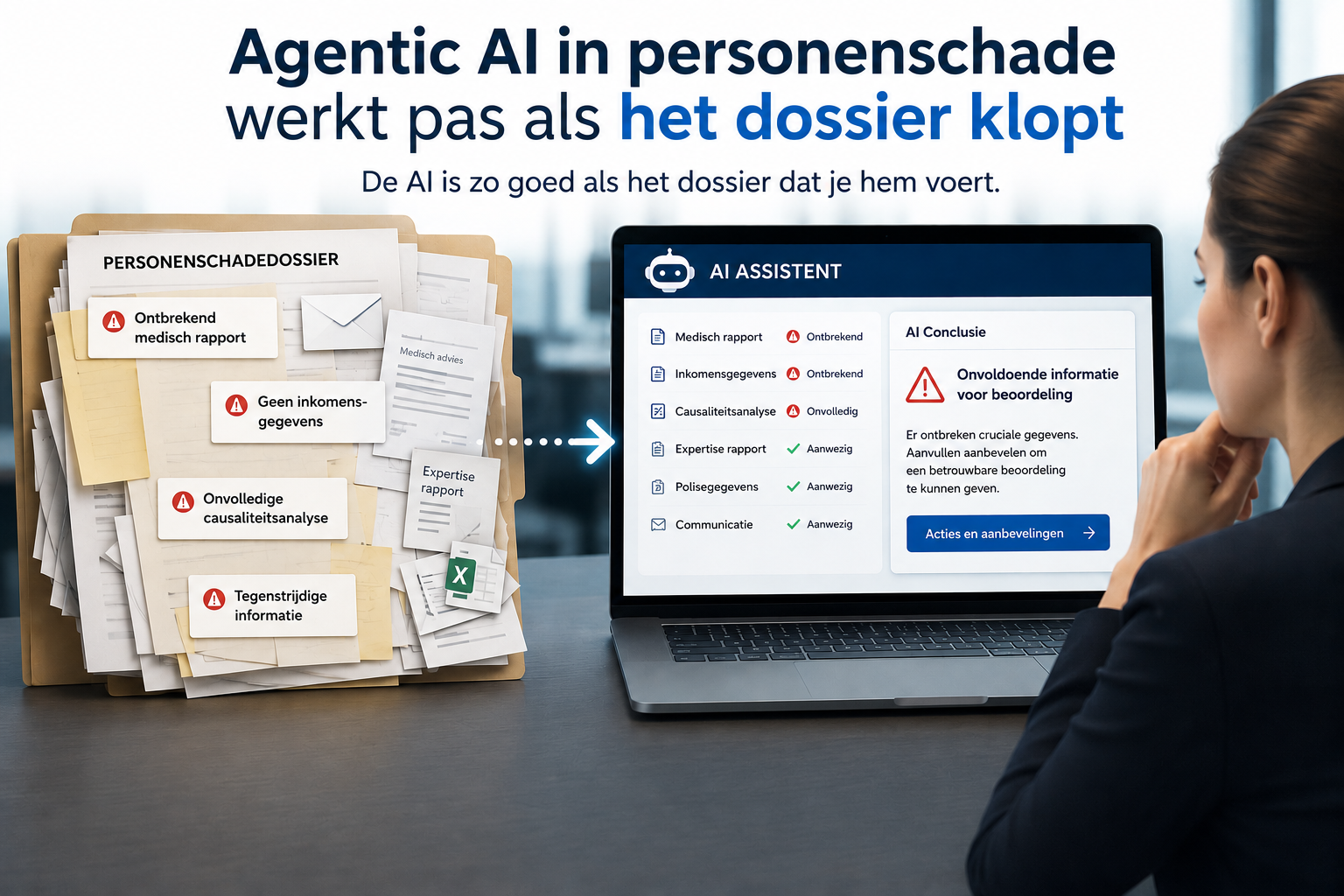

At the end of April, McKinsey published a report on agentic AI at insurers (link). The message: AI can finally handle the old systems and processes. Great. But if you handle a personal injury file every day or manage a team, the real question is a different one. Does that AI also work on your file?
The promise, and the catch
McKinsey shows that the gain is not in the clever model. It is in the boring underside: accurate rules and complete information brought together from separate systems. Translated to personal injury, that is simple. The AI is only as good as the file you feed it.
And you know that file. A notification by email. A medical advice you have to request three times. An expert report as an attachment. A claimant representative calling for an update you do not yet have yourself. Loose emails, Excel lists, a partner portal from a previous decade. Put an AI agent on top of that and it inherits exactly that mess: incomplete, contradictory, fragmented. Fast mess is still mess.
Why 93 per cent get stuck
Sedgwick surveyed AI at insurers worldwide: 82 per cent use it, 7 per cent got it working at scale (our analysis). That gap is not in the technology. It is in the file beneath it. A pilot runs fine on ten tidy cases. In practice every personal injury file runs differently, and that is where the AI falls over.
What that means for you
For the claims handler: less time in the mailbox and chasing documents, more time for the victim. For the manager: shorter turnaround times, lower cost per file, fewer Kifid cases and a grip on what happens in the chain. The victim finally knows where they stand, without having to call for an update.
What we do
We rationalise the data and streamline the claims process, and in doing so make AI work for insurers, in the broadest sense. A layer over your existing systems, not a replacement project. Four things do the work.
Claim360 connects to your policy and claims systems, including the old ones, and brings all claim information together, clean and in real time. That is the accurate file AI can run on.
Azori is the workplace on top. Claims handler, victim, claimant representative and loss adjuster each see what belongs to their role, in your own house style.
Solution-Hub delivers practice-proven building blocks for intake, assessment, communication and reporting. 80 per cent is ready to go, the other 20 per cent we configure together around your process.
The AI is plug-and-play. Whichever solution or model, in-house or via a partner. Within fixed guardrails, with the human in control and every action logged. ISO 27001 , GDPR by design, DORA-ready, GBL-compliant.
The order is what counts. First get the data in the file right, then put the AI on top. The other way round does not work, and that is why 93 per cent get stuck in pilots. If you want to see how this works on your own personal injury process, request a demo.
Sources
• McKinsey & Company, 'Can agentic AI (finally) modernize core technologies in insurance?', April 2026