AI in personal injury claims does not start with AI.

How it is built
Self-service first. Then automation. Then AI.
Every layer runs on the one below it. So an AI plan starts at the bottom, with data that is structured at the source. Reverse that order and you build a pilot that never scales.
How it is built
The translation to MCP, that is Claim360
AI
- summary
- triage
- flagging
- drafts
AI gets a file it can read, with the same permissions as the user asking the question. Every question is logged and traceable. Which model that is, is your call: your own model, a partner's, or our Claimassistent.
Any model the client wants
- Own model
- OpenAI
- Claude
- Copilot
- …
Every partner its own AI technology, connected once.
Automation
- triggers
- deadlines
- tasks
- documents
- payments
Automation can only act on what the system knows. Deadlines, tasks and triggers work because the data underneath is right. What the system knows, nobody has to watch.
Claim360 the MCP gate, where wanted
- permissions per role and per person
- every question logged and traceable
- headless API, exactly what someone may see in the portal
Self-service
- intake in fields
- data quality at the source
- only what each party needs
- one file
Self-service delivers fields instead of attachments: required, validated and linked to the head of damage. Every party enters and sees only what its role needs, nothing twice. That is the data quality automation and AI rest on.
Structured case data
Fields, heads of damage, messages and documents, rationalised at the source by self-service. Every party delivers exactly what the file needs, from intake to closing.
The customer journey
One line, six stations
The same claim runs from the first click to the closed file. Under every step runs the same engine, and at every step AI already takes part.
The engine under every step
- Intake
- Extraction
- Verification
- Policy check
- Analysis
- Communication
- Workflow
-
1 Notification
Capture everything correctly once, in eleven steps.
- Intake
- Extraction
- Verification
Agentic AI support for the handler Free text becomes fields. Every document read and checked for authenticity.
-
2 Receipt
Triage, routing and confirmation, right after sending.
- Policy check
- Analysis
- Workflow
Agentic AI support for the handler Four routes based on the intake. The handler keeps the last word.
-
3 Portal
Guided tour, tasks and conversations in one place.
- Verification
- Communication
- Workflow
Agentic AI support for the handler Every message comes with a draft reply, sources attached.
-
4 Statement of loss
Heads of damage with receipts, every document checked.
- Intake
- Extraction
- Verification
Agentic AI support for the handler The receipt becomes a line item. Genuine, unique and on time.
-
5 Assessment
AI prepares, the handler decides.
- Policy check
- Analysis
- Communication
Agentic AI support for the handler Draft position with sources, reserve with reasoning. The decision stays human.
-
6 Closing
Settlement, payment and file closed.
- Communication
- Workflow
Agentic AI support for the handler The settlement agreement drafted from the file, final payment without retyping.
The Claim360 philosophy
- In correctly, once. After that the file does the work. Fields instead of attachments, checked at the source, nothing retyped.
- AI reads, checks and prepares. The workflow writes back to the core system. Every step logged, every outcome available as management information.
- The handler decides. With personal injury a decision never goes straight through. The gain is in all the work around it.
Where the money is
Nine use cases, three kinds of value
Time, quality or claims cost. Not everything at once: start with three, measure against a baseline, and scale what works.
- Claims cost
Fraud detection
Unusual patterns across heads of damage, parties and history, on the file itself. Never an automatic rejection: a flag with reasoning, routed to a specialist.
- Quality
Flagging
Missing substantiation, duplicate items and deadlines about to start running, raised before they become a problem.
- Time
Workload overview
Per handler and per team: what comes first, what is waiting, what escalates. The day starts with what needs attention, and why.
- Time
Communication prepared
A draft reply per head of damage, in your organisation's tone of voice. The handler reads it, adjusts it and sends it.
- Time
Summary and triage
On arrival, handover and escalation: what is going on, and what the next step is. Long threads in a single line.
- Claims cost
Reserving proposal
The reserve follows from the heads of damage, history and policy, as a proposal on the item, with the reasoning and sources attached.
- Quality
Policy and cover check
Cover, excess and conditions checked against the core system, at the moment the claim comes in.
- Time
Document classification
Every document recognised, checked for authenticity and attached to the right head of damage. Amounts come back as a proposal.
- Claims cost
Straight-through handling
A complete file within bandwidth can be settled without intervention. With personal injury it never is: there the handler decides.
In the product
Four moments from one file
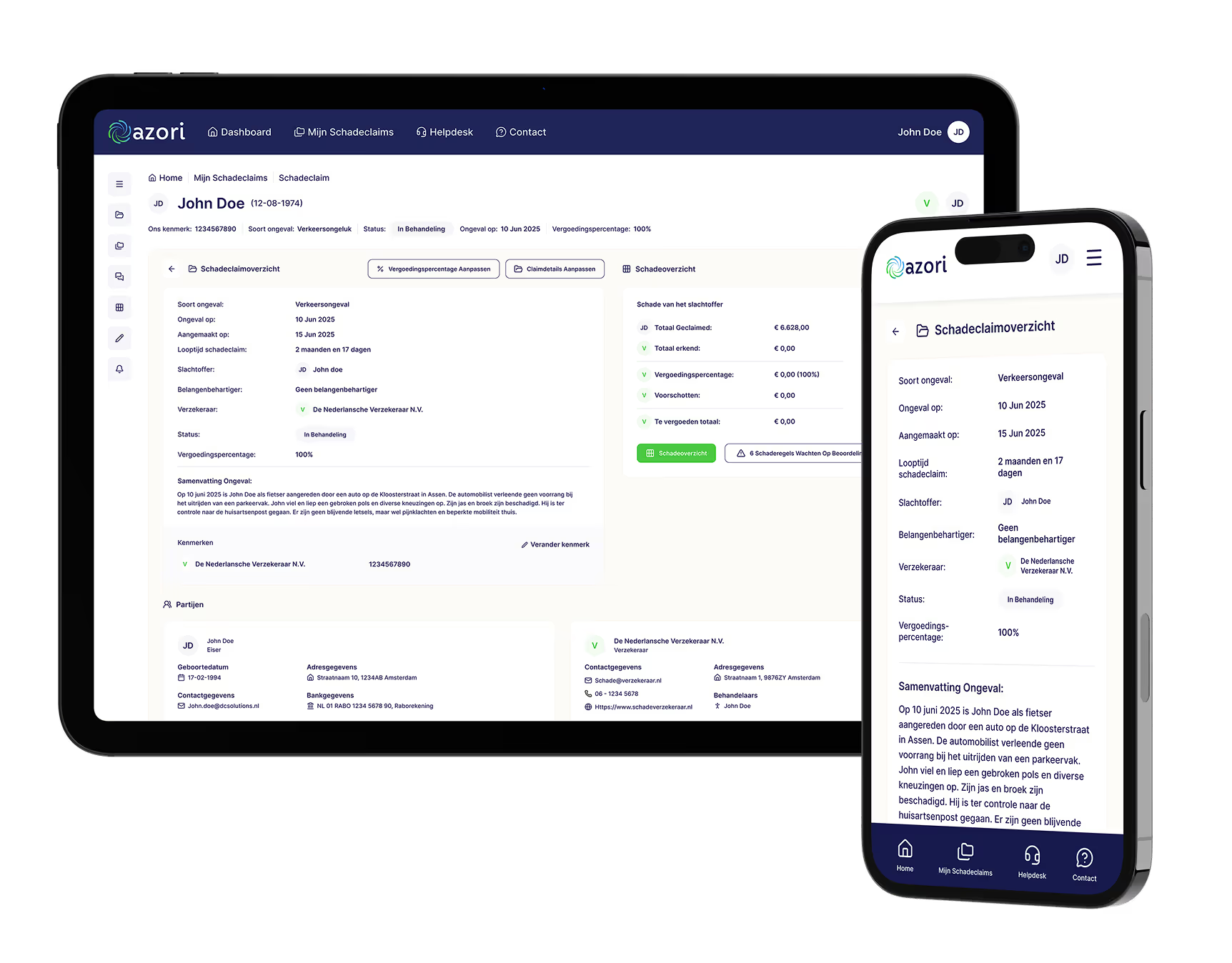
From the first notification to the statement of loss. The files below are fictional; this is the Azori working environment on Claim360.
-
Notification, step 2 of 11
Does this claim belong with you?
Registration in, vehicle register and policy alongside. The person filing knows straight away whether they are in the right place. Anyone not insured with you is pointed to the right insurer or the guarantee fund up front. No file is created. Details known from earlier claims are flagged on arrival.
Quality
Date of the incident 12-08-2026Registration of the other party 84-JHB-2 Vehicle register · Volkswagen Polo · grey · 2019This vehicle is insured with us Volkswagen Polo, grey. You can file your claim here.Fraud indicator: the same phone number and email address as in file LS-2025-01187. Flagged with reasoning, never rejected automatically.
-
Assessment, start of the day
The day starts with what needs attention
The handler's control view: what needs attention today, why, and what is already prepared. The Claimassistent went through 23 files and sorted them by deadline, flag and urgent need for money.
Time
Today 4 All files 23 Deadlines 4 Flags 2 Waiting on third parties 6Good morning Lotte
Four files need your attention today. The rest is on track.
Search file, name or reference23 active files 3 new this week4 deadlines this week first in 4 days2 open flags 1 fraud, 1 quality6 drafts ready waiting for your approvalToday first sorted by the Claimassistent on deadline, flag and need for money
SS.M. de ProefThe account contradicts itself: the text says junction, the sketch says roundabout. The claimant needs money.
Input quality Position · 91 days leftJJ. GarciaAdvances of € 1,500 exceed the acknowledged share of € 696.25. A further advance has been requested.
Flag Payment · 8 days leftRR. JansenThe liability position expires in 9 days. The draft letter is ready and the police record has arrived.
GBL deadline Position · 9 days leftTT. BakkerThe physiotherapy invoice also appears in file LS-2026-03911. Both documents are shown side by side.
Fraud indicator No deadlineClaimassistent 23 files reviewed at 07:30
Start with De Proef. One question to the claimant resolves the contradiction, and he indicated he needs money. The question is ready in his language and channel.
- Notification step 6, own words
- Situation sketch
- Step 8, needs money
- Summarise the Garcia file
- What expires this week?
- Show the draft position for Jansen
-
Portal, conversations
The answer is already prepared
Every conversation hangs on the file, with a draft assembled from the statement of loss and the open tasks. What the handler needs to know but the recipient does not, sits beside the message rather than in it.
Time
Claim overview Conversations Documents Statement of loss Reserving Tasks NotificationsDraft by the Claimassistent tone · businesslike, friendly
Thank you for your message. The loss of income up to 30 August (€ 3,200) is under assessment. We are still missing the payslips for July and August. Once they arrive we will assess the further advance and you will hear from us within two weeks.
- Statement of loss
- Payslips task, open since 11 Sep
Note, for you and not in the message: advances (€ 1,500) already exceed the acknowledged share (€ 696.25).
-
Portal, statement of loss
Claimed, demanded and acknowledged side by side
Every line with its substantiation, and the receipt read in as a line item. Claimant, representative and handler look at the same overview, each with their own permissions. A negative balance becomes a flag by itself.
Claims cost
Claim overview Conversations Documents Statement of loss Reserving Tasks NotificationsThe claimant's loss
- Total claimed
- € 6,195.00
- Total demanded
- € 6,135.00
- Assessed loss, total acknowledged
- € 2,785.00
- Share of liability, 25%
- € 696.25
- Advances
- € 1,500.00
- Balance
- € -803.75
Loss of income up to 30 AugustClaimed € 3,200.00 · demanded € 3,200.00 · not yet acknowledged
Awaiting payslips
The screens above are rebuilt in our own design system. The case data is invented.
How AI gets access to the file

Permissions per role and person

Every question logged

No training on customer data

Revocable immediately
For AI partners
Become a partner?
One integration on Claim360, and your model works at every connected insurer. We handle permissions, logging and the structured case data; you keep the model.
- Permissions per role and per person
- Every question logged and traceable
- No training on customer data
Frequently asked questions about AI in claims handling
Not seeing your question?
Can AI assess a personal injury claim?
No. With personal injury the decision never goes straight through. AI prepares: it puts the accounts side by side, tests heads of damage against policy and standards, and writes a draft position with sources. The handler takes the position. The gain is in all the work around it, not in the decision.
Do we have to replace our claims system to use AI?
No. The friction that slows claims processes down sits in the coordination layer between systems, not in the core system. Axon, CCS, Guidewire or another solution stays where it is. Claim360 puts an orchestration layer on top, and that is where AI plugs in.
Is anything trained on our customer data?
No. The data stays with the insurer, the model stays with the supplier, and nothing is trained on customer data. Every question is traceable per insurer and access can be revoked immediately.
Which AI model do you use?
That is your call. Your own model, a partner's, or our Claimassistent. The layer underneath stays the same, so the technology on top can change without rebuilding the integration.
Why do you start with self-service instead of AI?
Because AI is only as reliable as the data going into it. Self-service delivers fields instead of attachments: required, validated and linked to the head of damage. Without that layer, every AI investment stays an isolated pilot.
How do we know whether it works?
With a baseline measurement up front. We measure administrative time per file, phone traffic, number of reminders and lead time per head of damage. After that the conversation is about figures instead of impressions.
What about the AI Act and the Dutch GBL code?
The GBL deadlines are tasks with a date, an owner and a counter: acknowledgement, position, payment and contact moments are monitored rather than tracked by hand. For the AI Act, what matters is that the decision stays with the handler and that every step is explainable and logged.
Can you show this live?
Yes. One intake and one technical walkthrough in a production environment at a Dutch insurer. After that you know what it means for your chain.