Use cases
Automate where you can. Human contact where it matters.

What self-service already does
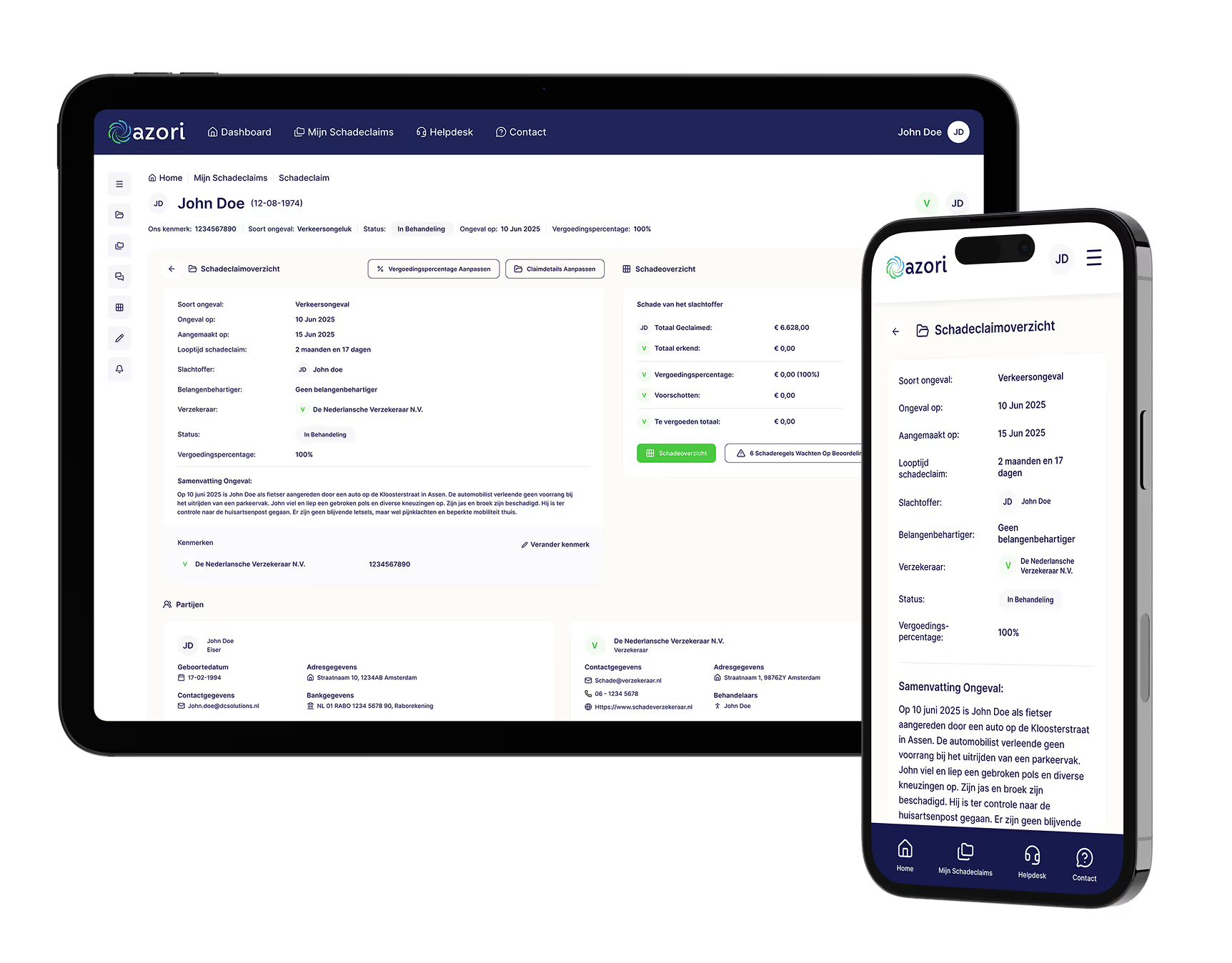
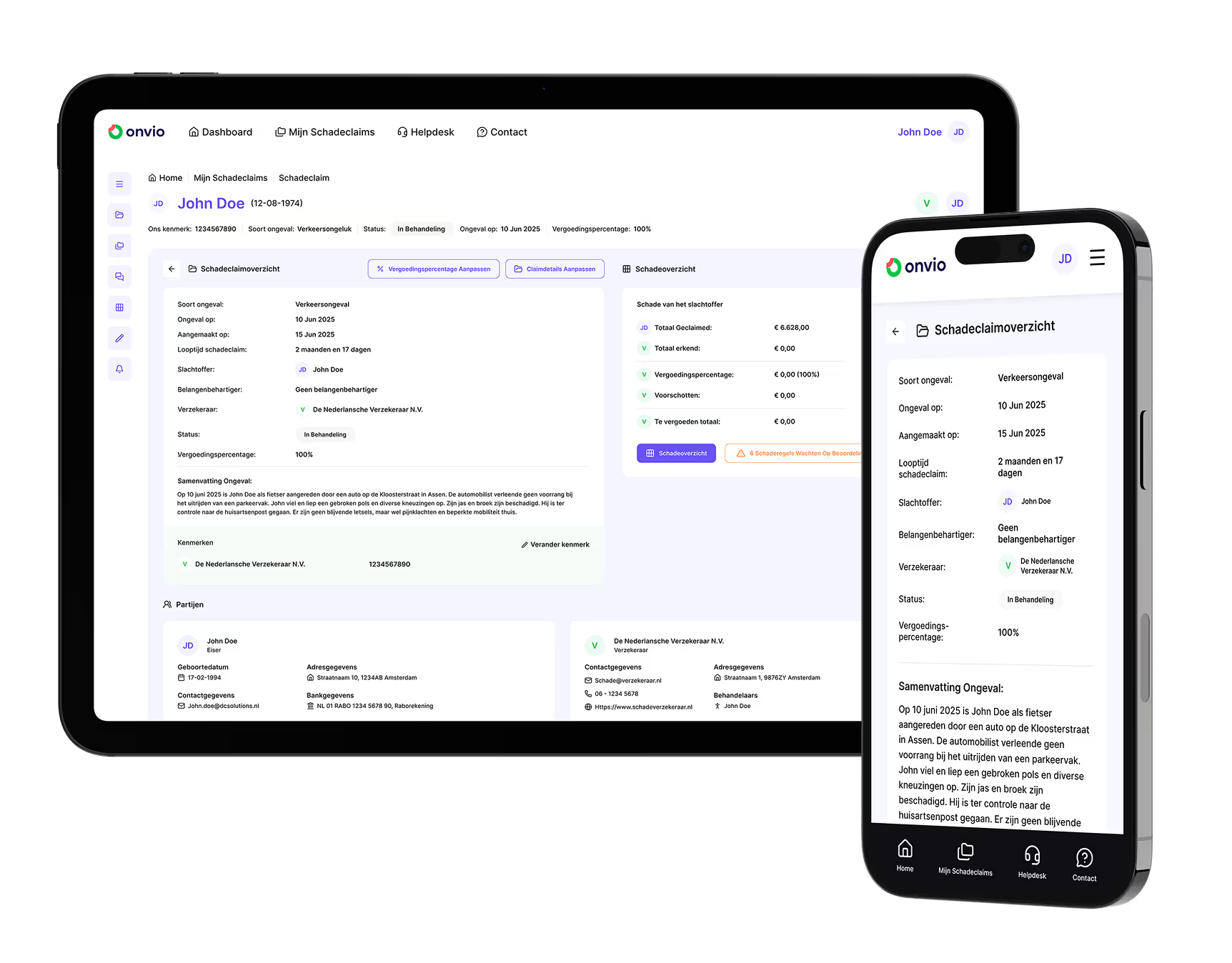
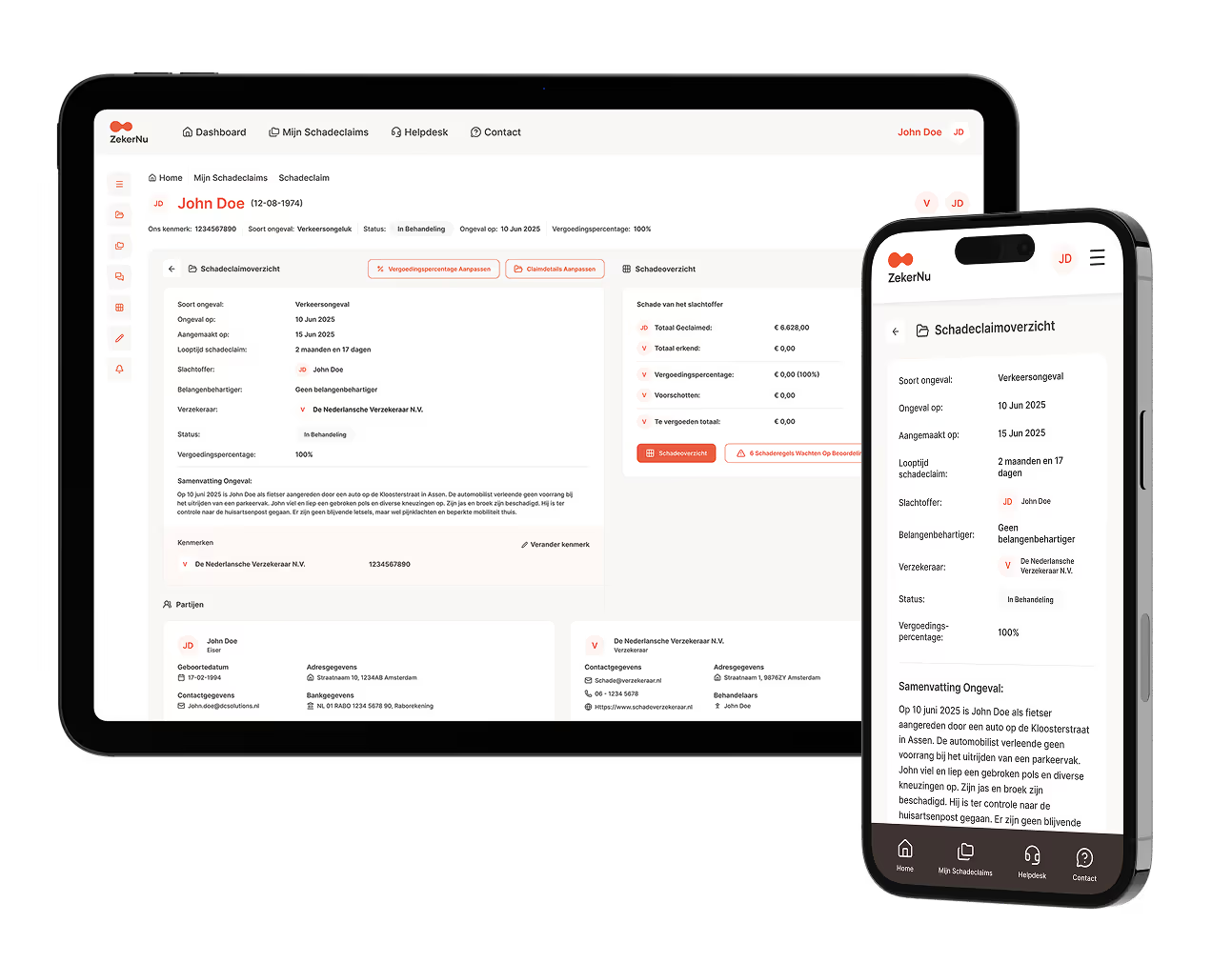
Self-service is not a form on a website. It is a file that explains itself, from notification to settlement, for every party with its own rights.
-
Notifying in fields
Without a policy number, in steps. What the claimant enters is read and checked. Nothing has to be retyped later.
-
Quick check
Registration in, DVLA and policy alongside. Cover on the date of the accident and a duplicate claim are in view at once.
-
What happened
Role, direction, right of way and point of impact come out of the claimant's story. If it does not match the sketch, one targeted question follows.
-
Documents
Photos and receipts are read and checked for authenticity.
-
Confirmation
A claim number, a named handler and the deadline for the liability decision, in the core system on day one.
-
File
Status, parties, interim payment and next step on one screen. Solicitor and medical expert work in the same file.
-
Schedule of loss
A photo of a receipt becomes a line in the schedule. The balance moves with it.
-
Settlement
The settlement agreement comes as a draft from the file and is signed in the portal.
Five situations at the insurer
The process is always the foundation. On top of it the insurer switches on what works: self-service, control and AI.
-
From notification to settlement, with the loss in view from the start
Situation and challenge
The insurer wants the whole route in order, from the first notification to the settlement. Today the time goes into correspondence about documents and amounts, and the loss itself comes into view late.
What is switched on
- Self-service
- The notification runs in steps. The claimant completes the claim form, gives the details of possible witnesses and puts the loss straight into the schedule of loss.
- -80% status requests
- -30% inbound calls and email
- Control
- On notification a policy and cover check and a fraud check run at once. Deadlines and tasks run along until the settlement.
- 35 to 80% less administration time *
- 8 to 42% shorter cycle time *
What it delivers
The loss is in view from the notification. With the schedule of loss the parties no longer exchange correspondence. The conversation is about what the claim really turns on: liability and the loss suffered.
-
A road traffic injury claim through Official Injury Claim
Situation and challenge
The claim arrives through Official Injury Claim, the official portal in England and Wales since 31 May 2021. Then it waits for the MedCo medical report, while solicitor, medical expert and rehabilitation provider each work in their own environment. The Consumer Duty asks for good outcomes the insurer can show.
What is switched on
- Control
- After the notification, deadlines and tasks run in one file, with an owner. The medical report is a task with a date.
- 8 to 42% shorter cycle time *
- Self-service
- Claimant and solicitor follow the file and supply documents. Reports land in the same file.
- -80% status requests
What it delivers
Every party sees its part of the same file. A claim that stands still is seen. Every action is logged and can be found in a review.
-
Three months to investigate liability
Situation and challenge
The letter of claim comes from the claimant solicitor by email. Under the Pre-Action Protocol for Personal Injury Claims the defendant replies within 21 calendar days and has a maximum of three months to investigate liability. Those dates sit in a diary, a workload or an inbox.
What is switched on
- Control
- The deadline runs as a task in the file, with an owner and a date.
- 35 to 80% less administration time *
- Self-service
- Claimant and solicitor supply documents in the file and see where it stands.
- -30% inbound calls and email
What it delivers
The deadline is in view before it expires. Everyone sees the same status, so nobody needs to chase.
-
Serious injury, a complete file from the start
Situation and challenge
The claim arrives by email, by phone and in a letter from the claimant solicitor. The handler retypes and keeps the protocol deadlines in a list of her own. Under the Rehabilitation Code a request for rehabilitation asks for a response within 21 days.
What is switched on
- Self-service
- The claimant notifies in fields, without a policy number. Claimant solicitor, medical expert and rehabilitation case manager connect.
- -80% status requests
- Control
- Protocol deadlines, interim payments and payments run by themselves.
- 5 to 28% lower claimant costs per claim *
- AI
- A summary on arrival and a schedule of loss as a proposal.
What it delivers
The file is complete at the start. Status and next step are in the portal, so nobody calls about them.
-
Income protection, from sickness notification to return to work
Situation and challenge
The claim arrives through the employer, the adviser or a PDF. The occupational health report is weeks on the road and the claimant does not know when the first payment comes.
What is switched on
- Self-service
- The claimant notifies in fields and sees the benefit and the payment date.
- -80% status requests
- Control
- Deferred period, benefit and review run as tasks. Medical only for those with the rights.
- 2 to 16% shorter benefit duration *
What it delivers
The claims assessor has time for the conversation with the claimant. A human always decides on the benefit.
The figures belong to the part, not to the example. Without an asterisk: measured at parties working with the portal. With an asterisk: from our model, depending on which layers are switched on.
Four situations in the chain
Chain control also starts at a partner, or next to a portal that is already there. Claim360 connects and leaves in place what works.
-
Your own portal for the claimant, Claim360 for the chain
Situation and challenge
The insurer has its own portal for the claimant and wants to keep it. Outsourcing partners and claimant solicitors still work by email and loose uploads.
What is switched on
- Portals
- Outsourcing partners and claimant solicitors each get their own portal on Claim360.
- Integration
- The insurer's own portal and the core system are connected through the API to the same file.
- Control
- Instructions, deadlines and reports run in one file.
What it delivers
The claimant stays in the insurer's environment. The chain works in the same file.
-
Files for several insurers in one environment
Situation and challenge
The firm handles claims for several insurers. Every client delivers differently and wants to be kept informed in its own way.
What is switched on
- Control
- The firm runs the file in Claim360, with deadlines and tasks per client.
- Integration
- The insurer sees status and documents in its own system or in its own portal.
- Self-service
- Claimant and claimant solicitor follow the file, in the insurer's brand.
What it delivers
One way of working for all clients. The insurer does not have to ask where the file stands.
-
One workplace for files at every connected insurer
Situation and challenge
The firm has files at several insurers. Documents go by email and the firm asks for the status by phone.
What is switched on
- Portal
- One environment for all files at connected insurers.
- Control
- Requests, interim payments and deadlines are lined up per file.
What it delivers
The firm sees per file what is running and what the next step is. Documents land straight in the right file.
-
Chain control for all customers, with one integration
Situation and challenge
Insurers ask their supplier for portals for claimant, claimant solicitor and experts. Building those is outside the core of the system.
What is switched on
- Integration
- One integration between the core system and Claim360, for every customer of the supplier.
- Portals
- Every insurer switches on what it needs, in its own brand.
What it delivers
The core system remains the source. The insurer gets chain control without migration.
Which situation looks like yours?
- One claim type to start with
- First pilot live in 8 to 12 weeks
- You decide on figures from your own claims