Personal injury 50% more expensive since 2022. Your AI pilot will not fix that.
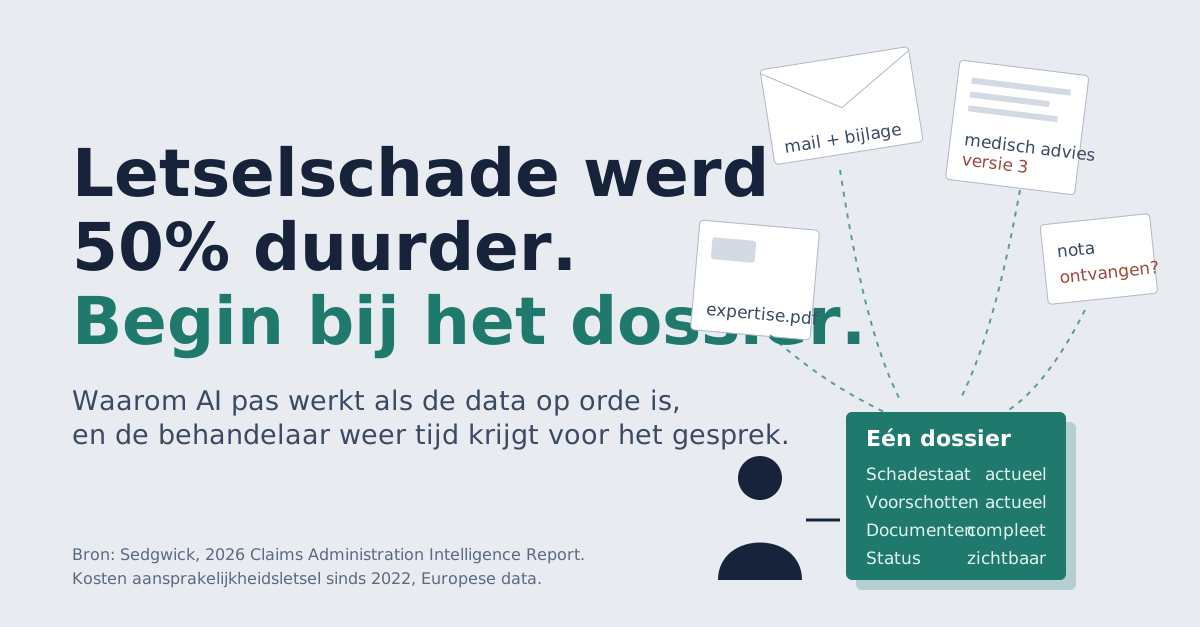

The cost of liability injury claims has risen by 50% since 2022. That is in Sedgwick's 2026 Claims Administration Intelligence Report, based on 2.3 million claims in Europe since 2020 [1]. These are European figures with a strong British slant. So it is not a Dutch benchmark. But every Dutch personal injury handler will recognise the mechanisms behind it.
Frequency is no longer the story. Severity is. The number of liability claims above £100,000 more than tripled between 2020 and 2025. The average claim in the most expensive 5% went from £20,000 in 2021 to £33,000 [1]. A small group of files determines an ever larger share of the claims burden.
Where the money goes
Sedgwick names three drivers: inflation on labour, care and legal costs, longer turnaround times and a shift towards complex files [1]. The second one gets too little attention in the Netherlands. A file that runs a year longer drags a year of extra wage and care inflation along with it. Turnaround time is simply a cost item.
How heavily care weighs is shown by Swiss Re. In a standardised scenario of a tetraplegic victim, care and assistance account for 72% of the total compensation in France, 67% in Germany and 61% in the United Kingdom [2]. The Netherlands is not in that selection. The lesson still travels: whoever wants to control costs in severe files steers on timely recovery, reintegration and a care plan that is right. Those are conversations. You have them with people.
The reflex: put AI on it
The market reaches for AI. Understandable. But look at the starting position; around 7% of claims are processed fully straight-through, and those are simple retail claims [3]. Personal injury sits at the other end of that spectrum. Multiple parties, medical information, advance payments and a statement of loss that keeps moving for years.
Put an AI agent on a file that consists of mail attachments, a medical advice requested three times and an expert report as a pdf, and it inherits exactly that mess. Sedgwick says it itself: digital triage is only as good as the data and models behind it [3]. The problem sits one layer lower. In the data.
Rationalise first
That is why our approach starts with one file context. Claim360 sits as an orchestration layer around the existing core claims system. In the Personenschadeportaal, victim, claimant representative, insurer and experts work with the same up-to-date statement of loss, advance payments, compensations, documents and status [4]. The core system stays. The fragmentation around it disappears.
Only when that basis is in place does AI have something to work on. Document extraction from labour or medical reports, classification of incoming correspondence, summaries for the claims handler and medical adviser, workflows that queue up the next task themselves [4]. Every application leans on the same file. Whoever reverses that order builds pilots that never scale.
Self-service removes the noise
According to Sedgwick, without AI around 30% of handling time goes to administrative work with little value [5]. In practice > 50% of the claims handler's working day goes to administrative tasks. In personal injury it sounds like this: 'where does my file stand', 'has my invoice arrived', 'when is the advance payment coming'. Every question costs the handler time and delivers the victim nothing.
Self-service solves that. The victim sees the status, submits documents themselves and follows the statement of loss. The claimant representative sees immediately what is missing and does not have to email about it. Transparency then becomes the default.
People first, technology as an amplifier
In personal injury, automation is never the goal. 77% of consumers want to speak to a human on complex or emotional claims [5]. The Gedragscode Behandeling Letselschade, the Dutch code of conduct for handling personal injury claims, puts personal contact and timely communication at the centre [6]. A severely injured victim wants to speak to someone who knows the file.
That is exactly where the gain of self-service and AI sits. The handler who no longer has to search calls earlier. The conversation about recovery happens in month two instead of month nine. That early conversation directly touches the cost drivers this piece started with: duration and rising care costs. Sedgwick names early technical triage and human expertise in the most severe files as the main levers for cost control [1].
Rules enforce the same order
Medical data is special category personal data under the GDPR. Fully automated decisions with significant consequences for a claimant are restricted, which pushes most applications towards decision support with a human assessor [3]. For the AI Act, Sedgwick advises recording human oversight at the moment of decision, with auditable logs. According to them, that is the first evidence supervisors will request [7].
Mind the timeline. The Sedgwick report names 2 August 2026 as the start date for the high-risk obligations [7]. That date has shifted. With Regulation (EU) 2026/1744, the Digital Omnibus on AI, in force since 27 July 2026, the obligations for standalone high-risk systems from Annex III apply from 2 December 2027. The transparency rules of Article 50 already apply since 2 August 2026 [8]. Whoever uses the extra time to get the file in order will be in good shape in 2027. A file in which every decision, every source and every human intervention sits in one place is the shortest route to demonstrable compliance.
Where you start tomorrow
Three questions for your personal injury team. How much handling time goes to status questions and chasing documents? Does the statement of loss of a file sit in one place, up to date for all parties? And what data does your AI pilot actually run on? And is it scalable and more widely applicable?
If the answer to the second question is no, that is your first project. AI comes after.
Curious what that looks like in your chain? Get in touch with us.
Sources
[1] Sedgwick, 2026 Claims Administration Intelligence Report, Chapter 1: Claims trends, p. 3, 7 and 9. Based on Sedgwick data: 2.3 million claims in Europe, 2020 to date.
[2] Swiss Re Institute, Motor Bodily Injury Landscape Report 2025, as cited in Sedgwick, Chapter 1, p. 21.
[3] Sedgwick, 2026 Claims Administration Intelligence Report, Chapter 2: The future, p. 15 and 17. The 7% figure comes, according to Sedgwick, from Aite-Novarica Group, STP benchmark 2023 (personal lines).
[4] Letselschade.NU, partner article DCSolutions, 'AI in letselschade: waarom pilots vaak vastlopen', May 2026.
[5] Sedgwick, Chapter 1, p. 13. The 30% figure is an internal Sedgwick benchmark (2025). The 77% figure is cited by Sedgwick; the source list mentions Legal Futures (2024) among others.
[6] De Letselschade Raad, Gedragscode Behandeling Letselschade (GBL).
[7] Sedgwick, Chapter 2, p. 9 and 13.
[8] Regulation (EU) 2026/1744 (Digital Omnibus on AI), published in the Official Journal of the EU on 24 July 2026.