AI in claims handling does not start with AI.
The agents do the paperwork. The people do the contact.
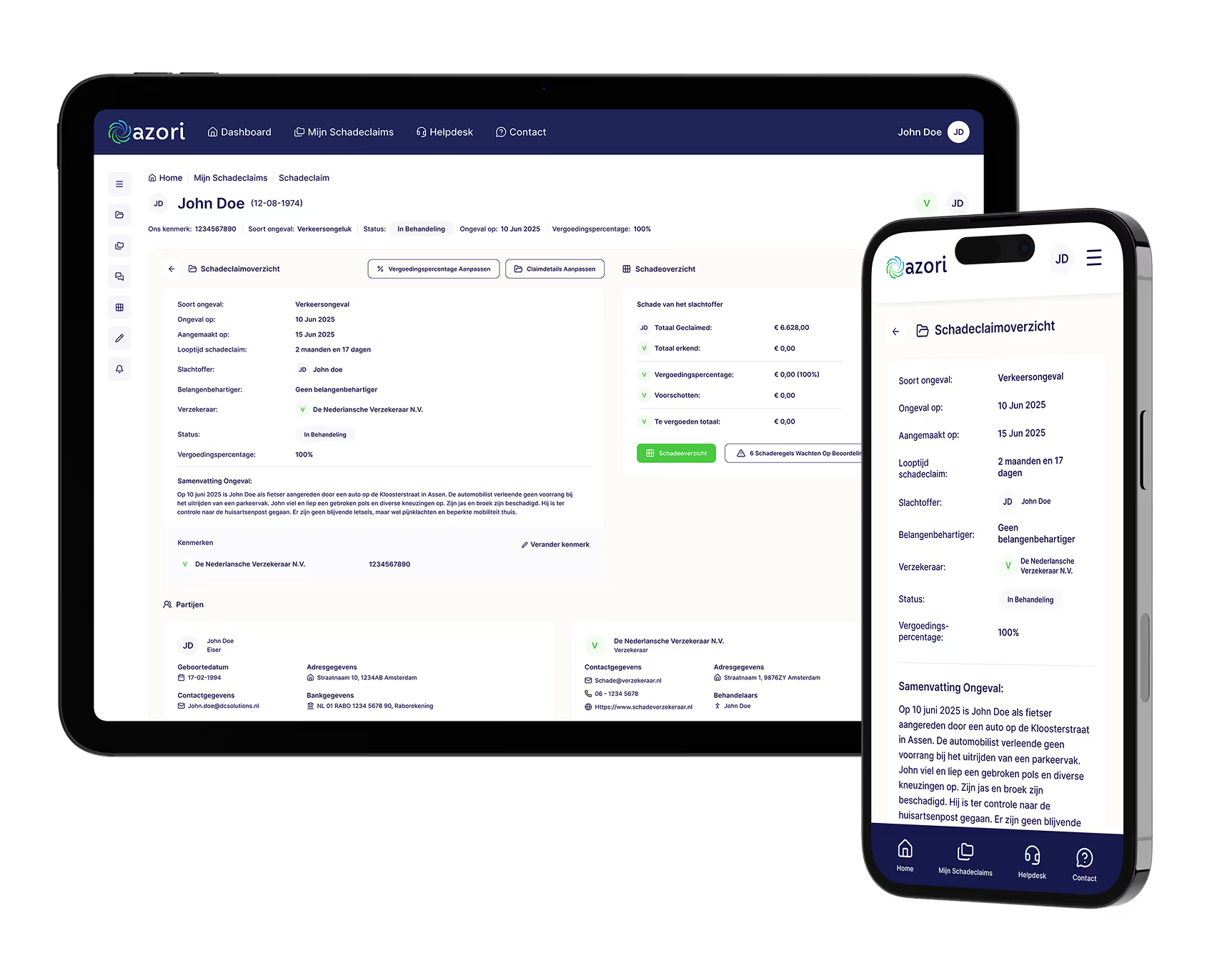
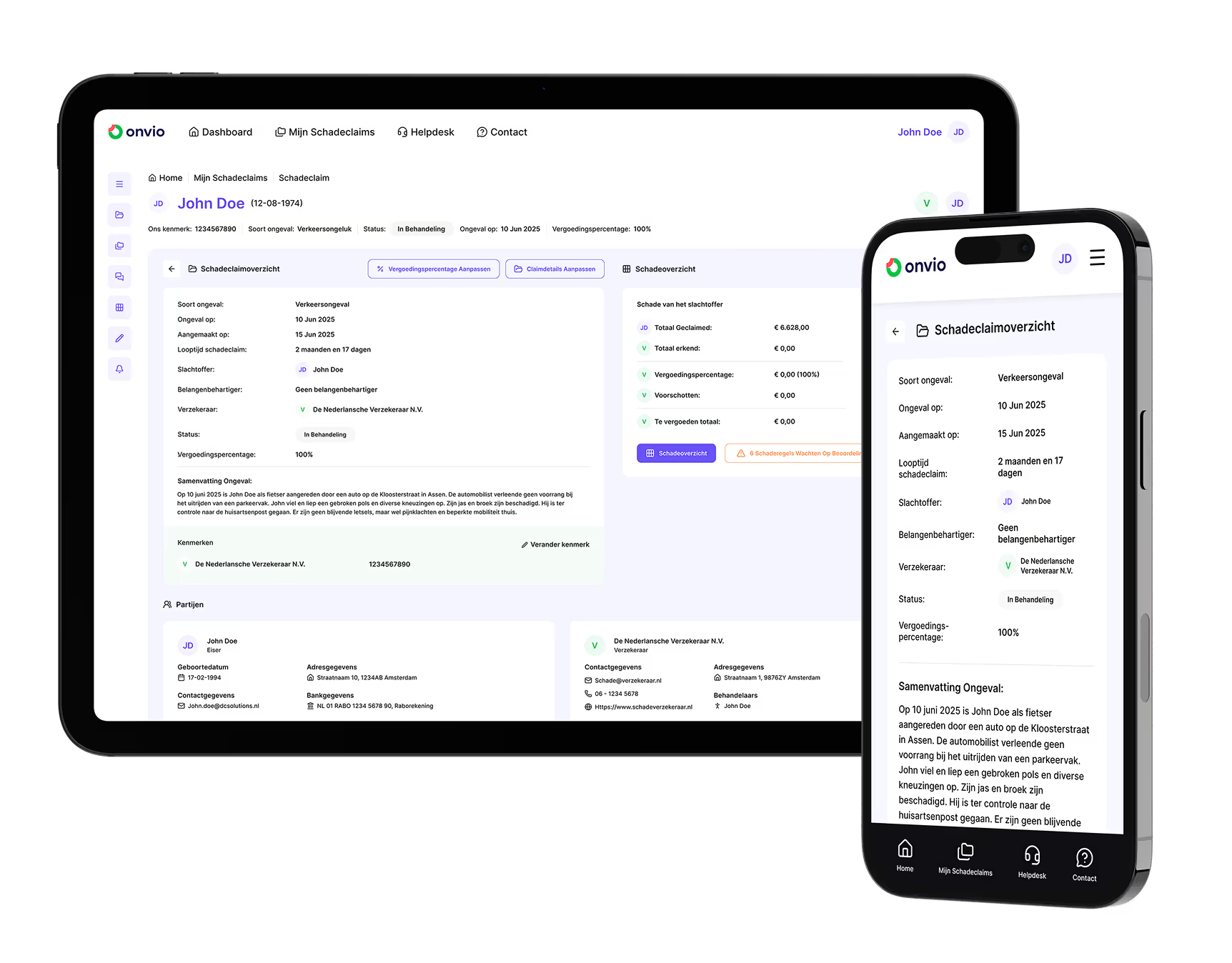
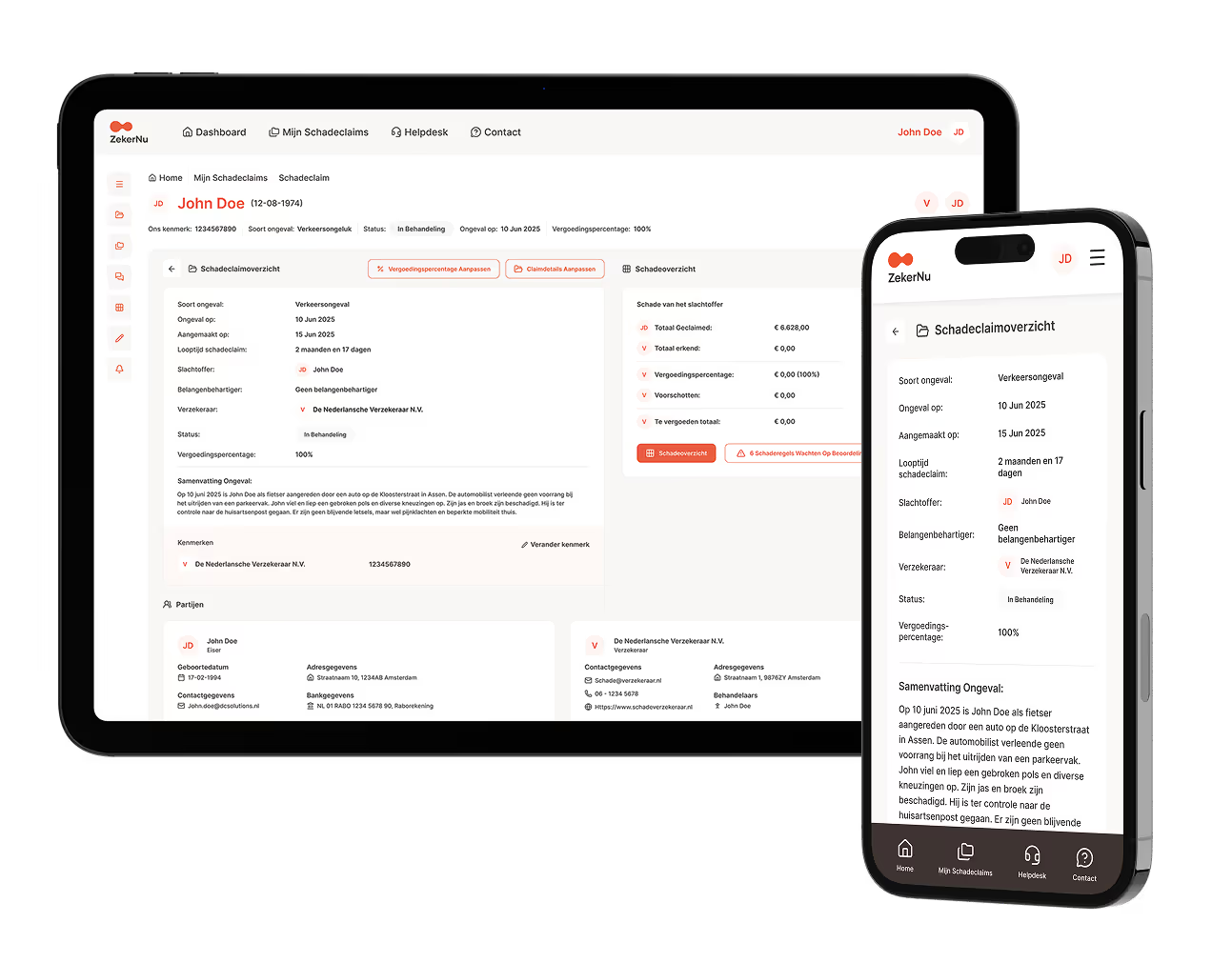

Claim360 first. Then the portal. Then AI.
Every layer runs on the layer below: the portal on Claim360, AI on both. Whoever starts at the top builds a pilot that never scales.
AI
- summary
- triage
- signals
- drafts
Reads, checks and prepares. With the same permissions as the user, and every question is logged.
Self-service portal
- intake in fields
- one file
- everyone sees along
Every party delivers fields instead of attachments. Required, validated and linked to the right head of damage. Runs on Claim360.
Claim360: orchestration and workflow automation
- deadlines
- tasks
- payments
- writing back to the core
This is where the intelligence sits. Deadlines, tasks, documents and payments run by themselves, because the system knows the data. What has to go back, goes back to the core.
One line, six stations
The same claim runs from the first click to the closed file. Under every step the same engine runs, and at every step AI already helps.
Station 1 of 6
Notification
Collect everything properly once, in eleven steps.
The engine under this step
- Intake
- Extraction
- Checks
AI support for the handler
Free text becomes fields. Every document read and checked for authenticity.
Station 2 of 6
Receipt and liability decision
Triage, route and confirmation, then liability.
The engine under this step
- Assessment
- Analysis
- Workflow
AI support for the handler
Based on the data, the sketch and all circumstances, AI shows what is still missing for a sound liability decision, or drafts a position with a clear explanation. The handler has the last word.
Station 3 of 6
Portal
Tour, tasks and conversations in one place.
The engine under this step
- Checks
- Communication
- Workflow
AI support for the handler
On every message a draft reply is ready, with sources.
Station 4 of 6
Schedule of loss
Heads of damage with receipts, every document checked.
The engine under this step
- Intake
- Extraction
- Checks
AI support for the handler
The receipt becomes a line in the schedule. Genuine, unique and on time.
Station 5 of 6
Quantum assessment
The handler sets the limits and decides beyond them.
The engine under this step
- Assessment
- Analysis
- Communication
AI support for the handler
AI reads the income from payslips and tax returns and assesses all heads of damage on that basis. AI also sees what is still missing in the file. The decision stays human.
Station 6 of 6
Closure
Settlement, payment and file closed.
The engine under this step
- Communication
- Workflow
AI support for the handler
The settlement agreement as a draft from the file, final payment without retyping.
A working day with the Claimassistent
Income protection insurers
Income protection notification
Payslips become fields. The deadline for the first payment runs as a task.
Period, employer and gross pay (£3,850.00) are fields in the file.
Signal, deadline first payment: 12 days left. The 2025 tax return is missing, the question to the claimant is ready.
Claimassistent summary of the intake
The notification is complete except for one document. Three payslips are read and linked, the 2025 tax return has been requested. The benefit has not been assessed yet.
- Intake, step 3
- Payslips May to July
Income protection insurers
Start of the day
The Claimassistent puts at the top which files need attention today: a deadline, a missing document, a review.
Good morning Sarah
Three files need your attention today. The rest is running.
Today first sorted by the Claimassistent
Deadline for the first payment in 12 days; the 2025 tax return is still missing.
Review scheduled for 15/02/2027; the vocational rehabilitation report is in.
The rehabilitation provider has posted a progress report; the status for the claimant has been updated.
Claimassistent 18 files reviewed at 07:30
Two deadlines run this week, one document is missing and has been requested. No signals on the other fifteen files.
- Deadlines per file
- Document check
Income protection insurers
Medical assessment
The medical officer's report lands in the file. The Claimassistent summarises for those with the rights; the medical officer decides on incapacity.
Read and attached to the file; the claims assessor sees only the conclusion and the next step.
Claimassistent summary for the medical officer
The report is complete. The limitations are described; the question about capacity from 1 December is open. The judgement is for the medical officer.
- Medical officer's report
- Intake, step 3
Signal, deadline: the assessment must be recorded within 10 days to pay the first benefit on time.
Income protection insurers
Benefit and review
Benefit and reserve go back to the core system. The review runs as a task, with a date and an owner.
Scheduled; the claimant and the medical officer see the date in the file.
Claimassistent state of the file
The benefit is processed and written back. The review is scheduled. Nothing is waiting on a human.
- Core system, benefit
- Tasks per file
Fictional files and names in the Azori workplace on Claim360.
Eight use cases, three kinds of value
Start with three, measure against a baseline and scale what works.
-
Time Injury and income
Summary and triage
On arrival, handover and escalation: what is going on and what the next step is.
-
Time Injury and income
Drafting communication
A draft per message, in your tone of voice. The handler reads, adjusts and sends.
-
Time Injury and income
Workload overview
Per handler and team: what first, what waits, what escalates.
-
Time Injury and income
Reading documents
Every document recognised and attached to the right head of damage. Amounts come back as a proposal.
-
Quality Injury and income
Signals
Missing evidence, duplicate items and running deadlines, flagged before they become a problem.
-
Quality Injury and income
Checking cover
Cover, excess and conditions checked against the core system on arrival.
-
Claims cost Injury and income
Fraud signal
Deviating patterns on the file, as a flag with reasoning for a specialist.
-
The handler sets the limits. Within them the agents handle, beyond them the handler decides.
How AI gets access to the file

Permissions per role and person

Every question logged

No training on customer data

Revocable at once
The model changes. The layer underneath stays.
Your own model, a partner's or our Claimassistent: the insurer decides. If a better model comes along tomorrow, you switch without touching the file, the portal or the workflow. No lock-in on an LLM, and no lock-in on us: sovereignty over model and data stays with you.
- Every model through Claim360 as the gateway, with the user’s permissions
- Every question logged and traceable per insurer
- No training on customer data
What the regulator and the market ask, and what Claim360 records
-
AI Act
The EU AI Act sets requirements for high-risk AI. Which claims applications fall under it, and from when, is still being assessed legally; UK insurers follow their own regime. What Claim360 records already: the handler sets the limits and decides beyond them, every step is explainable and logged.
-
Consumer Duty
The FCA's Consumer Duty expects good outcomes for customers that you can evidence. What Claim360 records for that: who asked what, with which permissions, and what came out; status and next step visible to the claimant. No training on customer data.
-
Protocol deadlines
Set up for the deadlines of the pre-action protocols: acknowledgement, liability decision, payment and contact moments are tasks with a date, an owner and a counter, monitored instead of tracked.
Start with a pilot on one claim type
No big programme. The portal goes live, we measure, and then three use cases prove themselves on your own files.
-
Portal live
The self-service portal goes live on one claim type. From that moment notifications arrive in fields instead of attachments.
-
Baseline
Together we measure administration time, chasers and cycle time.
-
Three use cases live
On that one claim type, within 8 to 12 weeks.
-
Measure and scale
After six months we compare with the baseline and scale what works.
Frequently asked questions about AI in claims handling
Is your question not here?
Can AI assess a personal injury claim?
Minor injury can go straight through, within limits the handler sets in advance. Serious injury never. There AI prepares: it lays accounts side by side, checks heads of damage against policy and guidelines and writes a draft decision with sources. The handler takes the decision. The gain is in all the work around it, not in the decision.
Do we have to replace our claims system to use AI?
No. The friction that slows claims processes down sits in the coordination layer between systems, not in the core system. Guidewire, Duck Creek or another solution stays. Claim360 puts an orchestration layer over it that AI hooks into.
Is there training on our customer data?
No. The data stays with the insurer, the model stays with the supplier, and there is no training on customer data. Every question is traceable per insurer and access is revocable at once.
Which AI model do you use?
You decide. Your own model, a partner's, or our Claimassistent. The layer underneath stays the same, so the technology on top can change without rebuilding the integration. Bring your own LLM: a better model tomorrow, and you switch without touching the file, the portal or the workflow. No lock-in. Suppliers of AI models can reach us through the contact page.
What about the AI Act and Consumer Duty?
Protocol deadlines are tasks with a date, an owner and a counter: acknowledgement, liability decision, payment and contact moments are monitored instead of tracked. For the AI Act and for Consumer Duty it matters that the handler sets the limits and decides beyond them, and that every step is explainable and logged. Which claims applications count as high risk, and from when, is being assessed legally.