AI on a process from 2005 gives you a faster process from 2005

Almost every non-life insurer has an AI pilot running by now. Document extraction from medical reports, summaries for the claims handler, automatic classification of incoming mail. In the demo it works. Then it stalls.
Harvard Business Review published a piece this month by Masha Shunko (Foster School of Business) and Serguei Netessine (Wharton) that explains why. Companies speed up loose tasks and leave the workflow that delivers the actual value untouched. The figures they cite are uncomfortable. CEOs expect to roughly double their AI spending this year, from 0.8% to about 1.7% of revenue. At the same time only 12% of CEOs see both revenue and cost benefits, and 60% of organisations measure no EBIT effect at enterprise level yet. Harvard Business Review
Anyone working in personal injury is not surprised.
The problem sits in the chain
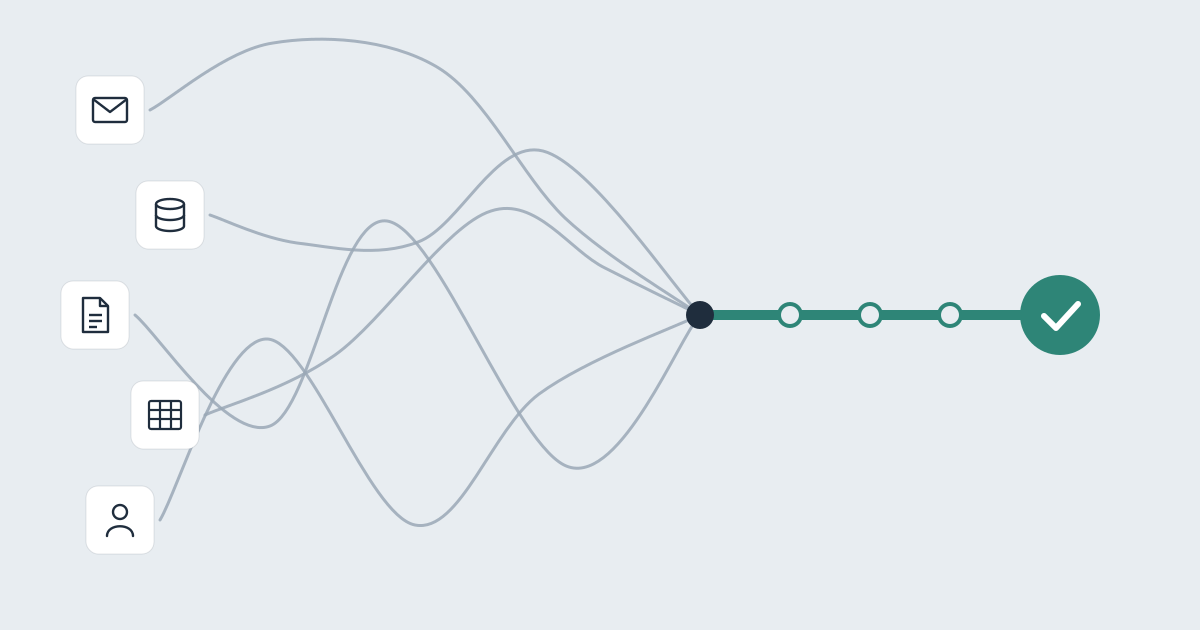
A personal injury file lives in five places at once. In the insurer's core system, in the claimant representative's mailbox, in the medical adviser's pdfs, in an Excel with the statement of loss and in the head of the victim who has heard nothing for three weeks.
Research by Utrecht University counted more than 14,000 personal injury cases running longer than five years. The researchers point to no single culprit: all parties involved contribute to the long turnaround time. Rapport onderzoek Langlopende Letselschadezaken
That is a chain problem. An AI that helps the handler through their mail faster delivers a faster mailbox. The victim is still waiting.
Start from the outcome
HBR names three choices. The first: decide what to redesign by looking at the outcome the customer values, the constraints AI can remove and what the system can keep learning from. Harvard Business Review
What does a victim value? Knowing where they stand. Fair compensation. A file that can one day close. The yardstick then becomes time to clarity. Time per action says little about that.
Take an advance payment request. In the current process the claimant representative emails a request with attachments. The handler gathers the documents, calculates, consults internally and emails back. The victim sees none of it. In a redesigned process the claimant representative submits the request on a shared statement of loss, AI checks whether the substantiation is complete, the handler approves and everyone sees the same status. The same decision, with a fraction of the noise.
Decide upfront where the human stays
The second choice is about human authority. The authors distinguish four modes (Assist, Approve, Audit and Automate) and choose per step based on how large a mistake can be and how easily it can be reversed. Harvard Business Review
In personal injury that translates well. A summary of a medical report is Assist: AI prepares, the medical adviser judges. An advance payment is Approve: AI proposes, the handler signs. Classification of incoming correspondence is Audit: it runs on its own, with spot checks. Acknowledgements of receipt, status updates and a signal when a file sits still too long are Automate.
Admission of liability and the settlement agreement always remain human work. You record that before the first line of code runs.
Design for the unhappy path
The third choice: record how the system recognises uncertainty, escalates exceptions, can stop or reverse actions and learns from corrections. Harvard Business Review
In personal injury the unhappy path is the main route. Debate about causation. A medical end state that fails to arrive. A claimant representative who switches. Complaints that worsen after a settlement proposal. A system that only works when everything goes right rarely works in personal injury. So AI must be able to say it is in doubt, hand the file back to a human and get better from every correction by the handler.
Redesigning without a replacement programme
Redesign sounds like five years of migration. It does not have to be.
Claim360 leaves the existing core claims system in place and forms the orchestration layer around it. For personal injury that is the Personenschadeportaal. Victim, claimant representative, insurer and experts work from the same up-to-date file context, with the same statement of loss, advance payments, compensations, documents and status in real time, set up along the GBL framework, the Dutch code of conduct for handling personal injury claims.
AI sits in the workflow itself. Think of intelligent intake, document extraction from medical reports, automatic classification of correspondence and summaries for handlers and medical advisers. The modules for intake, assessment, communication and reporting are ready and are activated per claim type and process, which makes it a configuration project rather than a development project.
The question for every claims director is therefore simple. Which process are you automating right now, and would you design it this way if you could start over? If the answer is no, that is where it starts.